
When There’s No Solution: How to Handle Impossible Situations in Parenting and Family Life
Mar 18, 2026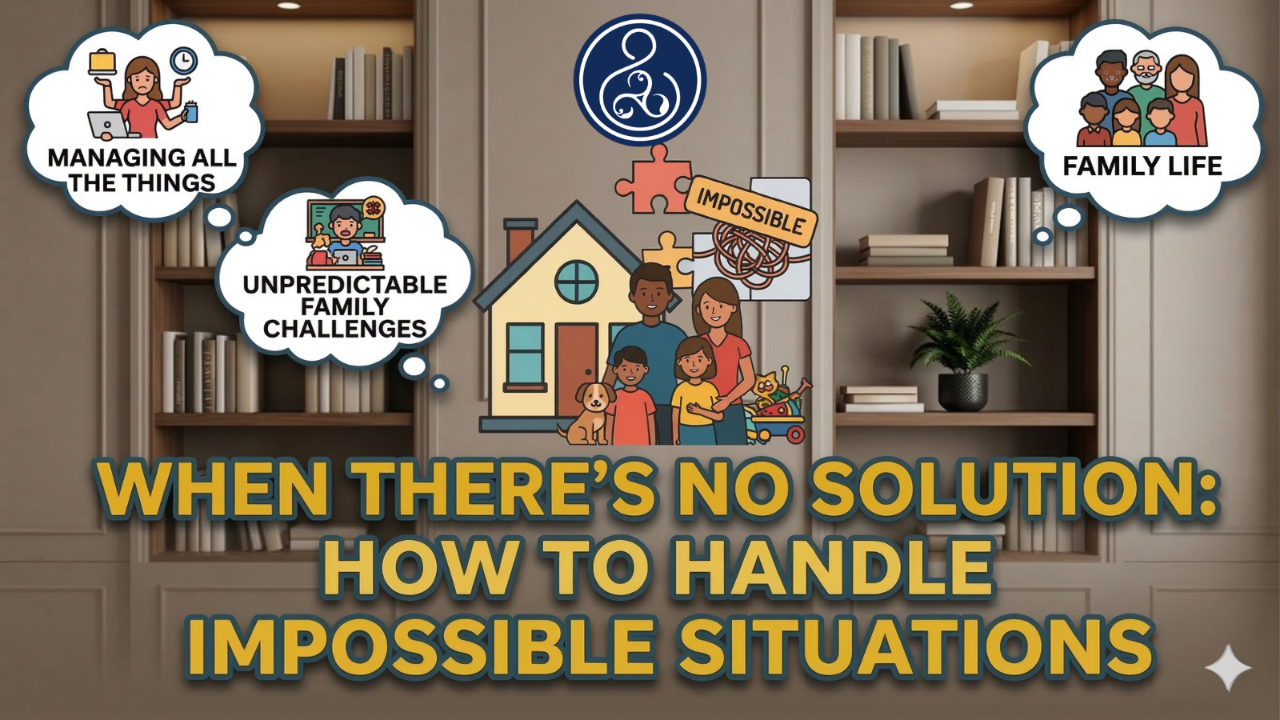
What do you do when a problem in your life doesn’t have a solution?
Not a hard solution.
Not a creative solution.
Not a “try harder” solution.
Just… no solution.
Most of us spend years believing that if we just find the right words, the right boundary, or the right strategy, we can finally fix the situation. And when it involves our kids or our families, that instinct gets even stronger.
But there’s a category of challenges that requires a completely different approach.
I call them impossible situations.
And learning to recognize them can completely change the way you experience your relationships, your parenting, and your peace of mind.
What Is an Impossible Situation?
An impossible situation is a dynamic where two things are true at the same time:
- Something would need to change for the situation to feel healthy or resolved.
- That change simply isn’t going to happen.
There’s a block that you cannot move.
For example:
💔 A parent who cannot give you the relationship you hoped for
⚡ A co-parent who remains committed to conflict
🏠 A family dynamic that never seems to evolve
🎒 A situation affecting your child that doesn’t have a better outcome available
In each of these cases, we can clearly see what would make the situation better.
But the reality is that the conditions required to create that change simply don’t exist.
And that’s what makes it an impossible situation.
Why Our Brains Struggle With Impossible Situations
When something matters deeply to us, our brains are wired to search for solutions.
We start asking questions like:
- “Maybe I just haven’t explained it the right way.”
- “Maybe there’s a boundary I haven’t tried yet.”
- “Maybe there’s still a way to fix this.”
This is especially true for parents, because protecting and helping our children is such a powerful instinct.
But when a situation is truly impossible, all of that mental energy turns into something else:
😵💫 Rumination
😵💫 Stress
😵💫 Emotional exhaustion
We stay locked in a loop trying to solve something that cannot be solved.
And the longer we stay there, the longer we delay the kind of peace and clarity that actually helps us move forward.
The Moment That Changes Everything
The real shift begins when we stop arguing with reality.
Not because we like the situation.
Not because we approve of it.
But because we recognize that fighting the truth isn’t helping anyone.
Acceptance doesn’t mean:
❌ Agreeing with what’s happening
❌ Approving of someone’s behavior
❌ Giving up on caring
Acceptance simply means:
➡️ You stop trying to make reality different than it is.
And when that happens, something powerful opens up.
You finally regain access to the part of your energy that can actually help.
A Real Parenting Example: When Co-Parenting Becomes an Impossible Situation
One example that comes up often with parents is co-parenting conflict after divorce or separation.
Imagine this situation:
A child wants to attend a specific school.
One parent agrees it’s a good fit.
The other parent refuses to approve it.
If both parents must sign off on the decision, the result is clear:
The child cannot attend that school.
That doesn’t mean the situation is fair.
It doesn’t mean it’s ideal.
It doesn’t mean the parent isn’t trying.
But it does mean the situation has reached the limits of what is possible.
And continuing to fight the unsolvable problem only drains the parent’s emotional capacity.
Once the situation is recognized as impossible, the focus can shift to something far more helpful:
🌿 Regulating the parent’s own nervous system
🌿 Supporting the child emotionally
🌿 Helping the child process disappointment
That’s where real support happens.
How the Enneagram Can Make This Even Harder
Certain personality patterns make impossible situations especially painful.
For example, Enneagram Type Ones often carry a deep sense of how things should be.
When reality doesn’t match the ideal, it can feel almost unbearable.
There’s a strong drive to:
- correct the situation
- fix the injustice
- make things right
But impossible situations confront that instinct directly.
They ask us to sit with something deeply uncomfortable:
The world isn’t always fixable.
And yet, we still have power inside it.
Where Your Real Power Is
When we stop trying to force a solution that doesn’t exist, our energy shifts.
Instead of trying to change what we can’t control, we can focus on what actually matters.
For parents, that often looks like:
❤️ Being emotionally present with your child
❤️ Helping them process disappointment or frustration
❤️ Modeling regulation and resilience
❤️ Showing them how to navigate hard realities
In other words, you move from fighting reality to supporting people inside reality.
And that shift can transform the experience for everyone involved.
Try This: The “Impossible Situation” Bucket
One simple mental tool that can help is what I sometimes call the “impossible situation bucket.”
When you notice yourself:
- obsessing over a problem
- replaying conversations
- trying to find the perfect solution
Ask yourself one question:
Is this an impossible situation?
If the answer is yes, the goal isn’t to solve it.
The goal becomes:
🧠 Processing your own emotions about it
🌿 Regulating your nervous system
❤️ Showing up differently within the situation
You’re not disengaging.
You’re just redirecting your energy toward what actually helps.
Final Thought
Impossible situations can feel like a trap.
From the inside, they can feel like torture.
But once we stop trying to make the impossible possible, something shifts.
We gain access to a new kind of clarity.
And often, that’s where peace, resilience, and better parenting begin.
Ready to Go Deeper?
If this idea resonates with you, you might already be noticing something in your own life that feels stuck, complicated, or harder than it needs to be.
That’s often the moment when coaching can be really powerful. Not because I hand you a perfect strategy, but because together we raise the level of awareness and clarity that makes the next step forward possible.
If you’re curious about what that kind of work could look like for you, you can learn more about working with me or book a free consultation here.