
Why Awareness Comes Before Change: What It Means When You Can See the Pattern but Still Can’t Stop It
Oct 07, 2026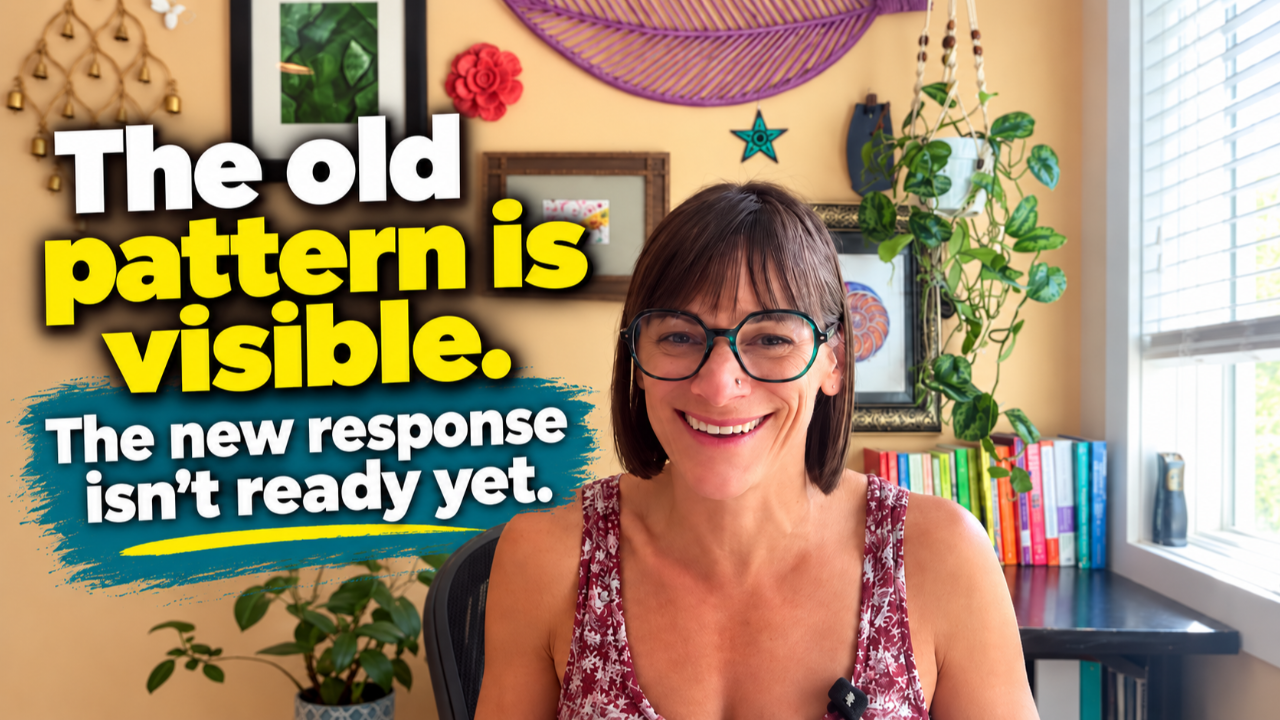
Have you ever watched yourself do the exact thing you promised yourself you weren’t going to do anymore?
You hear yourself snapping at your kid.
You say yes when you really want to say no.
You start managing everyone else’s feelings again.
You over-explain. Over-function. People-please. Try to control the outcome.
And somewhere in the middle of it, there’s this weird little part of you watching the whole thing happen like:
Oh my God. I’m doing it again.
Which would be one thing.
Except now you know better.
And somehow that makes it feel worse.
Because if you can see the pattern, shouldn’t you be able to stop it?
Not necessarily.
In fact, being able to see the pattern may be evidence that something important has already changed.
Awareness Is Not the Same Thing as Agency
One of the most frustrating stages of personal growth is the space between becoming aware of a behavior and actually being able to choose something different.
We tend to skip over that middle part.
We imagine change should work like this:
- I realize what I’m doing.
- I stop doing it.
- Congratulations, I am evolved now.
Wouldn’t that be convenient.
Real change is usually much messier.
First you do the thing without even realizing there is a thing.
Then you do it and notice afterward.
Then you notice while you’re doing it.
Then you notice right before you do it.
Then, eventually, you recognize:
Oh. This is one of those moments. I have a choice here.
And even then?
Sometimes you still choose the old thing.
That doesn’t mean you’re failing.
It means you’re developing the capacity to respond differently.
“I Know Better, So Why Am I Not Doing Better?”
This comes up constantly in coaching.
A client can identify the exact dynamic she keeps repeating with her ex.
She knows she doesn’t have to rearrange her entire life every time he asks for something.
She knows the request doesn’t work for her.
She knows she is slipping into the old habit of appeasing him, hoping that if she makes his life easier now, maybe he’ll be more reasonable later.
And then she does it anyway.
Afterward, she’s furious with herself.
“I did it again.”
“I haven’t changed.”
“What’s the point of seeing the pattern if I’m still doing it?”
I understand that feeling because I do my own version of it too.
There are moments in coaching when I get excited about a topic and start teaching instead of coaching. Suddenly I’m giving a small TED Talk.
Is there value in what I’m saying? Probably.
Is that always the way I want to show up as a coach? Nope.
And the especially annoying part is that I know I do it.
I can see it.
Which means I can also very easily decide that my awareness “doesn’t count” because I haven’t fully stopped the behavior.
That is exactly the trap.
We assume awareness only matters if it immediately produces different behavior.
But awareness is what makes different behavior possible in the first place.
The Part of Transformation Nobody Likes: The Goo
Think about a caterpillar becoming a butterfly.
Most of us imagine that if we could look inside the chrysalis halfway through the process, we would see something that looks partially caterpillar and partially butterfly.
Maybe a caterpillar with some little wing buds.
A work in progress, but recognizably headed in the right direction.
Nope.
Inside the chrysalis, much of the caterpillar’s body breaks down into something much closer to goo.
It does not look more like a butterfly.
It barely looks like anything.
And I think this is such an accurate picture of what personal growth can feel like.
There is often a stage where the old way of being isn’t working anymore, but the new way of being hasn’t fully formed yet.
You’re more aware.
You’re less comfortable.
You can see your patterns more clearly.
But you still don’t feel able to change them consistently.
Welcome to the goo.
Why Growth Can Feel Worse Before It Feels Better
Before you became aware of the pattern, you may have been operating almost automatically.
You didn’t know you were people-pleasing.
You didn’t know you were trying to control everyone’s emotional state.
You didn’t know that every time your kid struggled, a part of you interpreted it as evidence that you were failing as a parent.
Then you start paying attention.
And suddenly you can see it everywhere.
That can feel terrible.
There’s a strange innocence in not knowing.
Once you know, every repetition can feel like proof that you’re doing something wrong.
Especially if you have a strong inner critic, perfectionistic tendencies, or a habit of believing that “good people” should always do what they know is right.
But “know better, do better” is not always an immediate transaction.
Sometimes we know better for quite a while before our nervous system, habits, internal parts, and sense of safety catch up.
That is not a moral failure.
That is how deeply entrenched patterns work.
What Actually Changes First
Behavior is often one of the last things to change.
Before behavior changes, your relationship to the behavior changes.
At first:
I did it again.
Then:
I’m doing it again.
Then:
I’m about to do it again.
Then:
This is one of those moments where I usually do that thing.
And finally:
I can decide what I want to do here.
That progression matters.
Because the moment you can observe a pattern, there is already a tiny bit of distance between you and the pattern.
And that distance is where choice begins.
An IFS Way of Understanding This
In Internal Family Systems, we often talk about being “blended” with a part.
When you are fully blended with a part of yourself, its thoughts, fears, beliefs, and impulses can feel like the whole truth.
There isn’t much distance.
For example, a part of you might believe:
“If I disappoint this person, something bad will happen.”
“If my kid is unhappy, I need to fix it.”
“If I say no, I’m selfish.”
“If I’m not getting this right, I’m failing.”
When you begin to notice that part instead of simply acting from it, something has already shifted.
You can say:
There’s a part of me that really wants to say yes right now because it is terrified of conflict.
That is different from:
I have to say yes.
You may still say yes.
But now there is an observer.
There is some space.
And over time, that space can become agency.
The Enneagram Points to the Same Thing
The Enneagram is often reduced to personality types, but its deeper purpose is awareness.
It gives us a way to recognize the automatic strategies we use to stay safe, avoid pain, maintain control, earn approval, or preserve the identity we’ve built around ourselves.
The goal is not to become a “better type.”
The goal is to wake up enough to notice when your personality is running the show.
You cannot choose differently from a pattern you cannot see.
That’s why self-observation matters so much.
Not because noticing instantly fixes everything.
Because noticing is what eventually makes freedom possible.
This Matters in Parenting More Than You Think
Parents are especially hard on themselves during this stage.
You promise yourself you’re not going to yell.
And then you yell.
You tell yourself you’re going to stop over-explaining every boundary.
And then you find yourself ten minutes into a courtroom-style closing argument about screen time.
You decide you’re going to let your child have their feelings without trying to make those feelings disappear.
And then the second they get upset, every part of you wants to jump in and fix it.
If you notice what happened, your first instinct may be:
Great. I knew better and still screwed it up.
But there is another way to understand that moment.
Six months ago, maybe you didn’t even notice.
Three months ago, maybe you noticed three hours later.
Today, you noticed in the middle.
That is movement.
It may not be the movement you wanted.
It still counts.
Sometimes Someone Else Has to See Your Growth for You
One of the gifts of coaching — and especially group coaching — is having someone else witness your change while you are too close to it to see it.
You may think:
“I’m exactly where I was six months ago.”
And somebody who has actually been watching you for six months can say:
“No, you’re not.”
You might still struggle with the same person.
But now you can name what’s happening.
You might still get triggered.
But now you recover faster.
You might still make the same choice sometimes.
But now you know why you’re making it.
You might still be scared to set the boundary.
But now you recognize that the fear belongs to a protective part of you rather than treating it as proof that setting the boundary is wrong.
Growth is often much easier to see from the outside.
That’s one reason witnessing matters.
Sometimes we need someone to remind us that the goo is not the end of the story.
So What Should You Do When You Can See the Pattern but Can’t Stop It?
First, stop using awareness as evidence against yourself.
If you can see the pattern, something has already changed.
Then get curious.
Instead of:
Why am I STILL doing this?
Try:
What am I noticing earlier than I used to?
What happens inside me right before this pattern kicks in?
What does some part of me believe this behavior is protecting me from?
Is there even one moment where I have a little more choice than I had before?
Those questions create space.
And space is what allows something new to happen.
The Goal Is Not Perfect Behavior
The goal isn’t to become a person who never gets triggered, never people-pleases, never loses patience, never goes into control mode, and never falls into an old pattern.
That person does not exist.
The goal is to become more awake inside your own life.
To notice yourself.
To understand yourself.
To develop enough space between an impulse and an action that, little by little, you have more choice.
That’s self-leadership.
And sometimes the most important evidence that you’re changing is the exact thing you’ve been beating yourself up for:
You can finally see it.
You are not back at the beginning.
You’re in the middle.
You’re in the goo.
And the middle is where transformation happens.
Want Support While You’re in the Goo?
Sometimes it’s almost impossible to see your own growth while you’re living through it.
That’s one of the reasons coaching — and especially being witnessed in a group — can be so powerful.
If you’re noticing your patterns everywhere but still struggling to respond differently, my group coaching program gives you a place to understand what’s happening underneath those patterns, practice something new, and have other people reflect back the growth you may not be able to see yet.
www.annkaplanparentcoach.com/groupparentcoaching
You don’t have to arrive as the butterfly.
You can come exactly as you are.
And yes, goo is welcome.