
What Parents Miss When Every Moment Feels Make-or-Break
Jul 08, 2026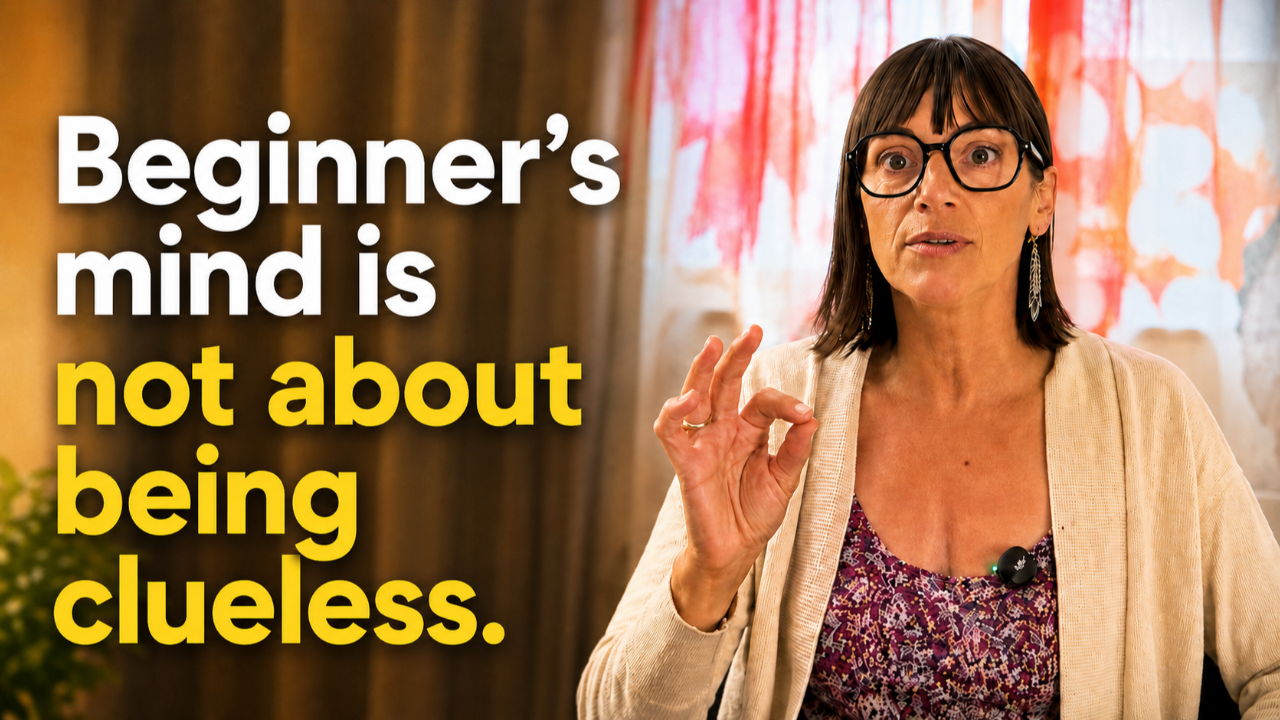
What is beginner’s mind in parenting?
Beginner’s mind in parenting means approaching your child, your relationship, and even the conversations you’ve had a thousand times with openness instead of assumption. It means letting go of the idea that you should already know exactly what to do, and allowing yourself to be present enough to actually notice what is happening now.
Which sounds lovely.
Also, if you are a parent, probably a little annoying.
Because when your kid comes to you with something big, or melts down in public, or asks a question you are not emotionally prepared to answer while you are making dinner and mentally calculating whether there is enough laundry detergent to survive the week, beginner’s mind is not usually your first instinct.
Your first instinct might be:
This is important. Don’t screw this up.
And there it is.
The pressure.
The moment stops being a moment and becomes a final exam.
Parenting is not a final exam
One of the biggest traps parents fall into is the belief that every important moment is the moment.
The make-or-break conversation.
The defining response.
The parenting test that will determine whether your child grows up emotionally healthy, secure, connected, and not writing a memoir about you someday.
No pressure. Super casual.
But when we treat parenting like a final exam, we usually become less present, not more. We start managing the outcome instead of attuning to the child in front of us.
We are technically there, but internally we are somewhere else entirely.
We are in the future, worrying about how this will turn out.
We are in the past, replaying what our parents did, what we promised we would never do, or what we messed up last time.
And meanwhile, the actual moment is happening without us.
That is what beginner’s mind helps interrupt.
The power of practice mode
Beginner’s mind is not about being clueless. It is not about pretending you know nothing or ignoring your experience.
It is about staying open enough that your experience does not become a prison.
I have a story about training for a race. A few days before race day, I ran the same distance with almost no pressure and absolutely crushed it.
I was practicing. It was low stakes. I was loose, present, and not trying to force the outcome.
Then race day came.
Suddenly, the same run became the thing. The moment I had trained for. The test. The proof.
And that pressure changed everything.
This happens in parenting all the time.
We are often much more connected, creative, and emotionally available when we are not trying so hard to get it right. The second we decide, This is the moment that proves whether I’m a good parent, our nervous system gets louder than our wisdom.
Practice mode gives us room.
Room to experiment.
Room to repair.
Room to notice what worked and what absolutely did not work and say, “Okay. Let’s try that differently next time.”
Which is basically parenting. Over and over and over again.
Why high-stakes parenting makes presence harder
When a parenting moment feels high-stakes, your system usually shifts into performance mode.
And performance mode is not the same as presence.
Performance mode says:
“I need to say the perfect thing.”
“I need to fix this right now.”
“I need to make sure my child understands.”
“I need this to go well so I can feel okay about myself.”
Presence says:
“What is actually happening here?”
“What does my child need?”
“What is happening inside me?”
“What is the next honest, grounded step?”
Those are very different energies.
And kids can feel the difference.
They may not have the language for it, but they know when we are with them and when we are managing them. They know when we are curious and when we are gripping the steering wheel with our emotional knuckles turning white.
Beginner’s mind helps us loosen our grip.
Not because the moment does not matter.
Because it does.
But because gripping does not create connection.
Your relationship with your child is a laboratory
One of the most helpful images from the episode is this: your relationship with your child is not a final presentation. It is a laboratory.
You are building something together.
Sometimes it works beautifully.
Sometimes it collapses like a Lego structure with one very questionable support beam.
And then you look at it and say, “Well, that did not hold. What do we need to build differently?”
That is the work.
Not perfection.
Not never messing up.
Not having the exact right script for every hard conversation.
The work is staying in relationship while you both keep learning.
Your child is learning how to be a person.
You are learning how to parent this specific child in this specific season while also dealing with your own inner parts, old stories, triggers, expectations, Enneagram patterns, nervous system habits, and whatever else is running the show behind the curtain.
So yes, of course you are going to miss it sometimes.
You are practicing.
Beginner’s mind and self-leadership
From an Internal Family Systems perspective, high-stakes parenting often happens when a part of us takes over.
Maybe it is the part that needs to be a good parent.
The part that is terrified of repeating family patterns.
The part that cannot tolerate being misunderstood.
The part that thinks if we do not fix this right now, everything will fall apart.
Those parts are not bad. They are usually trying very hard to protect us and our kids.
But they are not always the best leaders.
Beginner’s mind helps us come back into Self-leadership: more curious, more open, more grounded, more compassionate, and less attached to proving something.
It gives us just enough space to say, “Oh. A part of me thinks this has to be perfect. That makes sense. And also, maybe I can be here without letting that part run the whole conversation.”
That little pause can change everything.
Beginner’s mind and the Enneagram
The Enneagram gives us another useful lens here, because each type can turn parenting into a final exam in its own special, exhausting way.
A Type One might feel pressure to do it correctly.
A Type Two might feel pressure to meet every emotional need.
A Type Three might feel pressure to look like they are handling it.
A Type Four might feel pressure to make the moment meaningful.
A Type Five might feel pressure to understand before engaging.
A Type Six might feel pressure to prevent every possible future problem.
A Type Seven might feel pressure to keep things positive.
A Type Eight might feel pressure to stay in control.
A Type Nine might feel pressure to keep the peace.
Different patterns. Same basic trap.
We stop meeting the moment as it is, and start filtering it through the personality’s favorite safety strategy.
Beginner’s mind gives us another option.
Not a perfect option. Just a more honest one.
How to practice beginner’s mind as a parent
You do not need to overhaul your entire parenting approach by Tuesday. Please don’t. Everyone is tired.
Start smaller.
The next time you notice yourself thinking, I have to get this right, try asking:
“What would change if this were practice?”
Not fake practice. Not “this doesn’t matter” practice.
Real practice.
The kind that says: this matters enough for me to stay open.
You can also try:
“What am I assuming right now?”
“What would I notice if I had never seen this behavior before?”
“What is my child showing me, not just doing to me?”
“What part of me is making this feel so high-stakes?”
“What would it look like to respond from curiosity instead of pressure?”
These questions do not magically make parenting easy.
They just bring you back into the room.
And sometimes, that is the whole dang thing.
You are allowed to not already know
So many parents are walking around with this quiet, brutal expectation that they should already know how to handle everything.
The hard conversations.
The big feelings.
The sibling conflict.
The bedtime nonsense.
The teen years.
The tiny moments that somehow poke every unfinished place inside them.
But you are not supposed to already know everything.
You are supposed to be in relationship.
You are supposed to notice, learn, repair, adjust, and try again.
That is not failure.
That is parenting with consciousness.
That is growth.
That is what it looks like to build something real.
A gentle next step
Today, notice one thing you do all the time with your child.
Dinner.
Bedtime.
The ride to school.
The moment they start complaining.
The moment they ask for something after you have already said no 400 times and your soul briefly exits your body.
Just one thing.
And ask yourself:
“Can I meet this as if I have never been here before?”
Not because you are trying to become some serene parenting monk who never loses it.
Because there may be something new available in that moment.
A new response.
A new softness.
A new boundary.
A new repair.
A new way of seeing your child.
A new way of seeing yourself.
That is the gift of beginner’s mind.
It lets the relationship breathe again.
Frequently Asked Questions
What does beginner’s mind mean in parenting?
Beginner’s mind in parenting means approaching your child and your parenting moments with openness, curiosity, and less attachment to getting it perfect. Instead of assuming you already know what is happening or what the outcome needs to be, you stay present enough to respond to the actual moment.
How can beginner’s mind help overwhelmed parents?
Beginner’s mind helps overwhelmed parents by lowering the pressure to perform perfectly. It creates more room for curiosity, repair, flexibility, and emotional presence, especially during hard conversations or repeated parenting challenges.
Is beginner’s mind the same as gentle parenting?
Not exactly. Beginner’s mind is a mindset of openness and non-attachment. Gentle parenting is a parenting approach often focused on empathy, respect, and emotional regulation. Beginner’s mind can support gentle or conscious parenting because it helps parents stay curious instead of reactive.
Why do parents feel like every moment is high-stakes?
Parents often feel this way because they care deeply and are carrying old stories about what it means to be a good parent. Sometimes a present-day parenting moment activates fear, perfectionism, guilt, or unresolved emotional patterns from the parent’s own past.
What should I do when I mess up as a parent?
Pause, notice what happened, and repair when you can. A mistake does not ruin the relationship. Repair teaches your child that relationships can survive imperfection, honesty, and trying again.
How do I stop trying to be a perfect parent?
Start by noticing when perfectionism shows up. Ask what part of you feels responsible for getting everything right, and what that part is afraid would happen if you didn’t. Then practice shifting from performance to presence, one moment at a time.
Ready for a deeper reset?
The Fall Retreat is for women who are ready to step out of the noise, reconnect with themselves, and do the kind of growth work that changes how they show up in parenting, relationships, and life.
It is a space to practice presence, self-leadership, honesty, and expansion without turning your growth into another high-pressure performance.
Learn more about the Fall Retreat here:
https://www.annkaplanparentcoach.com/fallretreat