
The Mental Load of Motherhood: You’re Important… But You’re Not the Linchpin
Jun 17, 2026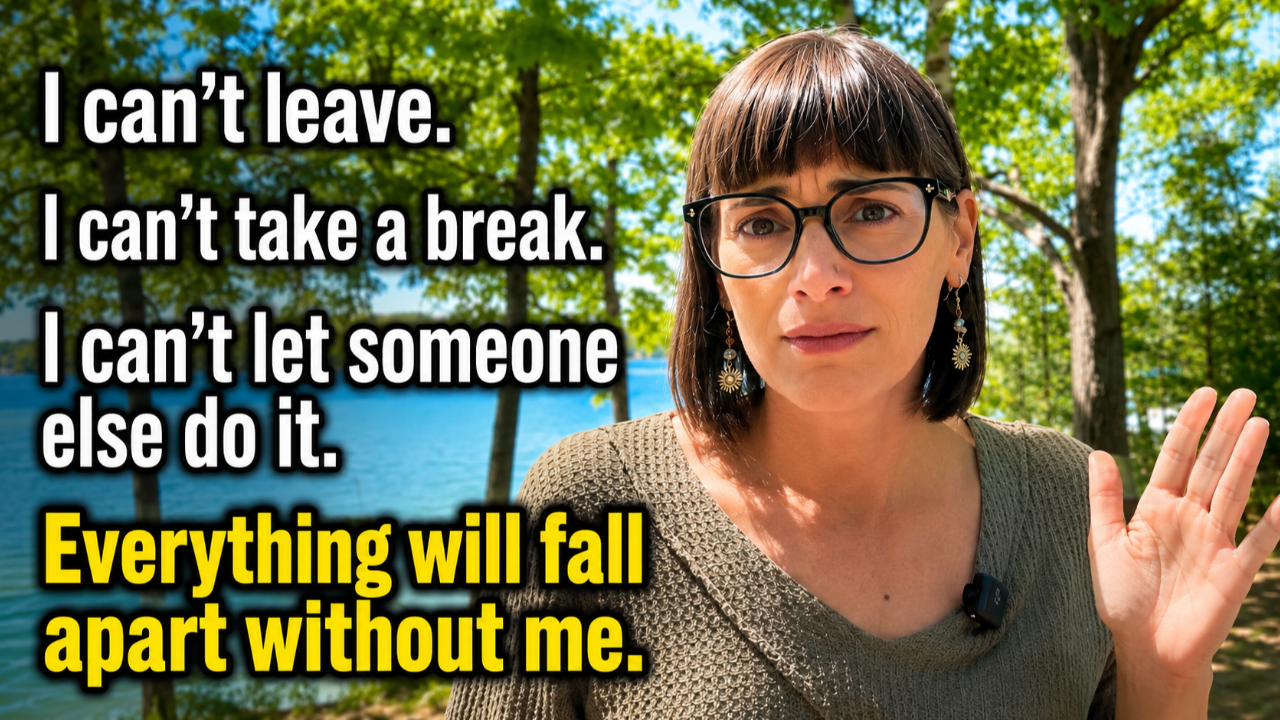
There is a particular kind of tired that comes from being the person who knows everything.
Not in a charming, “ask me anything” way.
More like:
who needs a snack, who has soccer, who hates the blue cup this week, who needs their permission slip signed, which kid is emotionally teetering, what’s for dinner, what’s in the dryer, what’s running low in the pantry, and what tiny change in bedtime will ruin everyone’s life.
And after a while, it starts to feel like responsibility.
Then it starts to feel like love.
Then, very quietly, it starts to feel like prison.
This is the mental load of motherhood. And for so many parents — especially moms — it comes with a story that sounds responsible on the outside but feels crushing on the inside:
I can’t leave.
I can’t take a break.
I can’t let someone else do it.
Everything will fall apart without me.
And listen. I get it.
I have lived this one.
When my oldest was little — less than two, because by the time he was two, he had a brother — I was invited to a close friend’s bachelorette weekend. And my immediate response was basically, “Absolutely not. I can’t go.”
Not because I didn’t love my friend. Not because I didn’t want to go. Not because there was literally no one else who could care for my child.
But because somewhere inside me, I had become convinced that I was the whole operation.
The bedtime.
The food.
The diapers.
The routine.
The responding-to-misbehavior plan.
The tiny little invisible parenting algorithm running in the background of every day.
I had finally figured out how to do motherhood, and that felt like relief. But I didn’t yet understand that it had also become a burden.
When “I Can’t” Isn’t Actually True
A friend challenged me on it.
Bless her, honestly, because she didn’t have kids yet, which meant I could have very easily dismissed her with the classic, “You have no idea what you’re talking about.”
But she kept pushing.
Point by point, she helped me see that the story I was telling myself wasn’t entirely true. Someone else could take care of my kid. Things might be done differently. Something might be a little off when I got home. But that was not the same as everything falling apart.
So I went.
And do you know what happened?
The roof stayed on the house.
The baby was alive.
The house had not burned to the ground.
Very rude of the universe, honestly.
But something else happened, too. Something much bigger than I expected.
My husband got to parent without me managing him.
He got to change the diapers his way. Feed the baby his way. Decide about the walk and the nap and the rhythm of the day without me hovering nearby with a helpful little, “Actually…”
And to be clear, we were not having some huge fight about this. He was not saying, “Stop infantilizing me.” I was not saying, “You’re doing everything wrong.”
It was subtler than that.
I had become the lead parent because I was the one holding all the information. He was following my lead because that was the system we had created. But neither of us realized that the system was quietly limiting both of us.
Over-Responsibility Can Look Like Love
This is the part that gets uncomfortable.
Because when you are the one carrying everything, it can feel selfless.
It sounds like:
If I don’t do it, no one will.
If I leave, they’ll struggle.
If I don’t manage it, it won’t be done right.
If my kid has a hard time, that means I failed.
But sometimes what looks like selflessness is actually over-responsibility.
And over-responsibility is sneaky because it often wears a very convincing “good parent” costume.
It says, “I’m just being responsible.”
But underneath, it may be saying:
I don’t trust anyone else.
I don’t know who I am if I’m not needed.
I feel guilty when I’m not useful.
I believe everything my child does reflects on me.
I think being a good mom means being constantly available.
That is not a character flaw. It is a pattern.
And patterns are exactly the kind of thing we can begin to see through frameworks like the Enneagram, Internal Family Systems, and deeper self-leadership work. Ann’s approach uses tools like IFS and the Enneagram to help clients build more awareness, clarity, and self-leadership instead of only trying to fix the external problem.
You Matter. You’re Just Not the Whole Bridge.
Here’s the hard truth, said gently:
You are important.
Deeply important.
Your family needs you. Your presence matters. Your care matters. Your love matters. Your steadiness matters.
And also?
You are not the keystone holding the entire bridge together.
The world will keep turning when you rest. Your partner may do things differently. Your kids may feel uncomfortable for a minute. The laundry may not be folded with your exact little emotionally loaded fold system.
But everyone may also grow.
Your partner may discover they are more capable than the family system has allowed them to be.
Your kids may discover that other people can care for them.
You may discover that being loved is not the same as being indispensable.
That last one can sting a little.
Because part of us may not want to admit that we’ve made ourselves more central than we actually need to be.
But there is freedom there.
Your Kids Need the Chance to Rise
One of the biggest surprises of stepping away is what happens to our kids when we are not there to smooth every edge.
This does not mean abandoning them or forcing independence before they are ready. We are not talking about disappearing for seven weeks and hoping everyone becomes emotionally enlightened.
We are talking about appropriate space.
A night away.
A weekend away.
A retreat.
A few hours where another adult is in charge.
A chance for your child to experience, “Mom leaves and comes back.”
A chance for your child to realize, “Other people can help me.”
A chance for your child to access a capability they have not needed to use yet.
Ann shares in the episode that when she goes away to run her retreat, her youngest often seems to “level up” while she is gone. Not because of drama or hardship. Simply because she is not there, so he does the thing.
It is the same as someone making you dinner every night. You may never cook, not because you are incapable, but because the system doesn’t require it.
Then one day, that person isn’t there.
So you make dinner.
And suddenly everyone remembers: Oh. You can do that.
The Mental Load Is Not Just About Tasks
When people talk about the mental load, they often talk about logistics.
The appointments.
The schedules.
The meals.
The laundry.
The remembering.
The planning.
And yes, absolutely.
But the deeper part of the mental load is not just carrying the tasks.
It is carrying the meaning.
It is believing that if your child struggles, it is your fault.
If your partner does something differently, you should have managed it better.
If the family drops a ball, it means you failed.
If you take a break, you are selfish.
If something goes wrong while you are gone, it proves you never should have left.
That is not just mental load.
That is identity load.
That is the burden of making everything about you — even the things that were never fully yours to carry.
And I say that with so much compassion because many of us learned this honestly. We were praised for being responsible. We were rewarded for being helpful. We were loved for being easy, capable, self-sacrificing, impressive, low-maintenance, or “so good.”
Then we became parents, and that old wiring got a promotion.
Suddenly, being over-responsible looked like being a good mom.
The Enneagram Question Underneath It All
This is where the Enneagram can be so useful — not as a label, but as a flashlight.
Different types may arrive at over-responsibility through different doors.
An Enneagram One may think, “I have to do it right.”
A Two may think, “Everyone needs me.”
A Three may think, “I should be able to handle this.”
A Six may think, “If I don’t stay alert, something bad will happen.”
An Eight may think, “I can’t rely on anyone else.”
A Nine may think, “It’s easier if I just do it and keep the peace.”
Different story. Same cage.
The work is not to shame the part of you that learned to carry so much.
The work is to notice it.
To get curious.
To ask: Is this actually love? Or is this fear wearing a responsible outfit?
What Happens When You Step Away
When you step away, even briefly, you may give your family a gift they could not receive while you were managing everything.
You give your partner the dignity of being trusted.
You give your kids the chance to adapt.
You give your nervous system proof that rest does not equal disaster.
You give yourself a tiny little opening to remember that you are a person, not just a function.
And yes, things may be imperfect.
That is not failure. That is family.
The goal is not to leave and come home to everything done exactly the way you would have done it.
The goal is to come home and realize that your way is not the only way everyone survives.
Maybe even thrives.
Ann’s brand of coaching is rooted in deep personal growth, self-awareness, and helping people stop trying to fix everything outside of themselves while avoiding the unfinished business inside.
Maybe the Break Is the Work
This is one of the reasons the retreat matters so much.
For some women, the biggest growth of the retreat begins before they ever arrive.
It begins when they say:
I am going.
I am spending the money.
I am taking the time.
I am letting people figure it out without me.
I am allowing myself to be held instead of holding everything.
That act alone can confront the exact pattern that needs healing.
Because sometimes the resistance to going is the material.
The “I can’t leave” is the doorway.
The guilt is the map.
The panic about everyone else managing without you is not proof that you should stay home. It may be the very thing asking for your attention.
A Gentle Practice: Test the Story
The next time you hear yourself say, “I can’t,” pause for a second.
Not forever. We are not turning this into a whole journaling retreat in the cereal aisle.
Just pause.
Ask yourself:
Is it true that I can’t? Or is it uncomfortable?
What am I afraid will happen if I step away?
Who might grow if I stop managing this?
What am I accidentally preventing by being so available?
What would change if I trusted the people around me a little more?
You do not have to blow up your whole life to begin.
Let someone else do bedtime.
Let the laundry be folded badly.
Let your partner take the kids without a 19-point instructional briefing.
Let your child struggle through a task they can probably handle.
Let yourself be unavailable for a little while.
Not because you don’t care.
Because you do.
And because caring does not have to mean carrying everything.
Final Thought
You are important.
So important.
But you are not the whole machine.
You are not the only adult.
You are not the only safe person.
You are not the only one who can figure things out.
You are not the only reason your family functions.
And that may be confronting.
But it can also be the beginning of so much relief.
The people you love may be more capable than your anxiety has allowed them to be.
And you may be more than the person who keeps everything from falling apart.
You may be someone who gets to rest.
Someone who gets to leave.
Someone who gets to come back and find that everyone is still there.
Maybe even a little stronger.
Ready to Stop Carrying It All?
If this hit a little close to home — the “I can’t leave,” the “no one else will do it,” the “everything depends on me” — this is exactly the kind of pattern we work with in coaching and on retreat.
Ann’s work blends parent coaching, the Enneagram, Internal Family Systems, and deep self-leadership to help you stop fixing everything outside of you and start shifting the patterns underneath.
Explore coaching or the fall retreat at: www.annkaplanparentcoach.com/fallretreat